I think that most of my posts during this semester were quite negative towards the internet (at least the social media aspect). So now I want to find something positive in this global network.
I'm a bookworm. I can easily read a book a day. Or two books if I have no deadlines. So during a single year the total number of books grow enormously. It is expensive to buy every time the hard copy. And quite often the book is not so good that you don't want to keep it anymore, so the hard copy becomes the useless placeholder on the shelf. And here comes the online world.
Thanks to the Internet I can get a new book in several clicks, for less money than the hard copy or even for free. I can take it from the library without leaving my apartment. And if I don't want to keep it anymore I just delete it, or on other hand, if I want to have it with me, I just save it somewhere in cloud, and I have this book anywhere at any time. In the Internet you can get reviews on the books you're thinking about, you can get personal recommendations based on the books you've read, so you can always fins a book you'll probably like.
Some negative things I've heard about reading e-books. Firstly, it can diminish the chance of the surprise new opening with a book you've never heard about (it happens when you come to the physical bookstore and just grab randomly), but nobody stops you from checking a link on a random book online, and perhaps you'l like it more than the random hard copy book because of reviews. Secondly, you don't have the physical contact with a book, you don't feel the pages, you don't smell it (I know people like to smell books). But as a student I value the convenience more than the comfort. I would rather take any number of books I need on my Kindle that doesn't take nearly any space in my bag than I would take just one book that makes my bag to heavy to carry around campus.
And just one life example about why I love e-books. Everybody knows the Harry Potter books. When I first read them I was 7, and I had to wait for 2 years until the last book was published and then several more months for the translation. The translation was really good (later, when I became better in English, I compared the original version and the translation). But after some time publishers decided to republish the whole series of the Harry Potter books with the new translation. And it is awful, you can barely read it if you know how it can be and how it should be. Fans were in despair, they begged to republish the old translation, but the answer was no. So now it is nearly impossible to buy the hard copy books with the old translation, people who have them prefer to keep them for themselves, or they are really expensive. But you can definitely find the e-book with the old translation. I have all 7 of them on my computer, and I'm happy that I can keep the part of my childhood with me. And my children will be able to read the "right" version of Harry Potter (or they can learn English and read the original version, but it is another story).
Saturday, April 28, 2018

#10 (Andrew Krump)
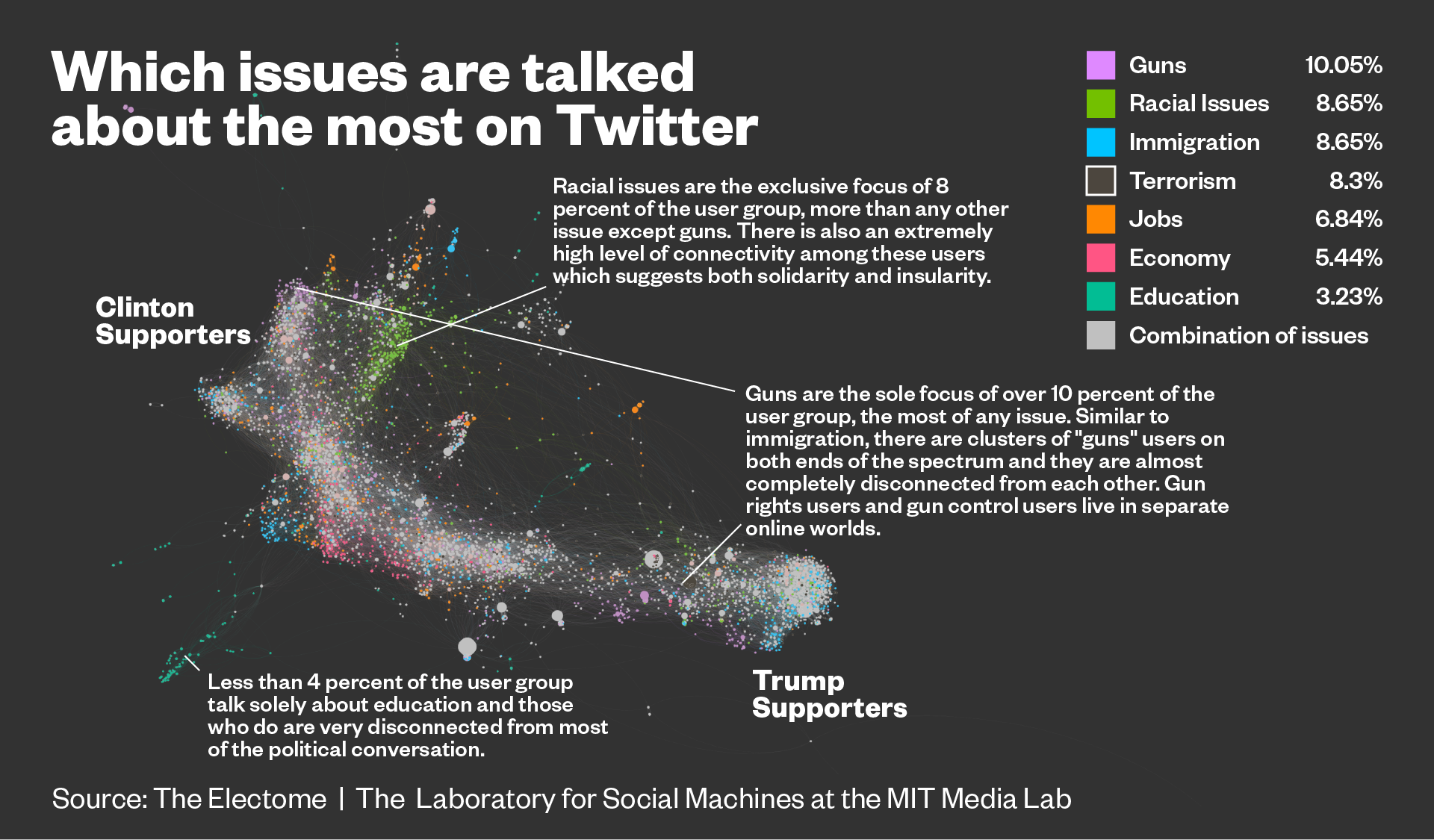
I remember seeing a Vice News piece on a study that MIT did examining the connections and discussion habits of Clinton and Trump supporters on Twitter (article is at https://news.vice.com/en_us/article/d3xamx/journalists-and-trump-voters-live-in-separate-online-bubbles-mit-analysis-shows). The researchers assembled a series of diagrams showing the Twitter universe and how groups are connected. The results are pretty amazing and point very clearly to the "echo chamber" nature of social media users.
The researchers found that Trump supporters (just follow Trump) associated very little with Clinton supporters (just follow Clinton) or those who follow both Clinton and Trump. They found that following only one candidate predicted actual political support very well.
On issues like gun control, those who actively discuss the issue tend to fall solidly into either Clinton or Trump's camp and don't interact much. This is pretty scary to me considering that we always hear about how social media and the internet can help expose people to other viewpoints. I see this research as a strong indication that there is a tendency (at least at the political extremes) to reinforce existing beliefs, not facilitate meaningful dialogue.
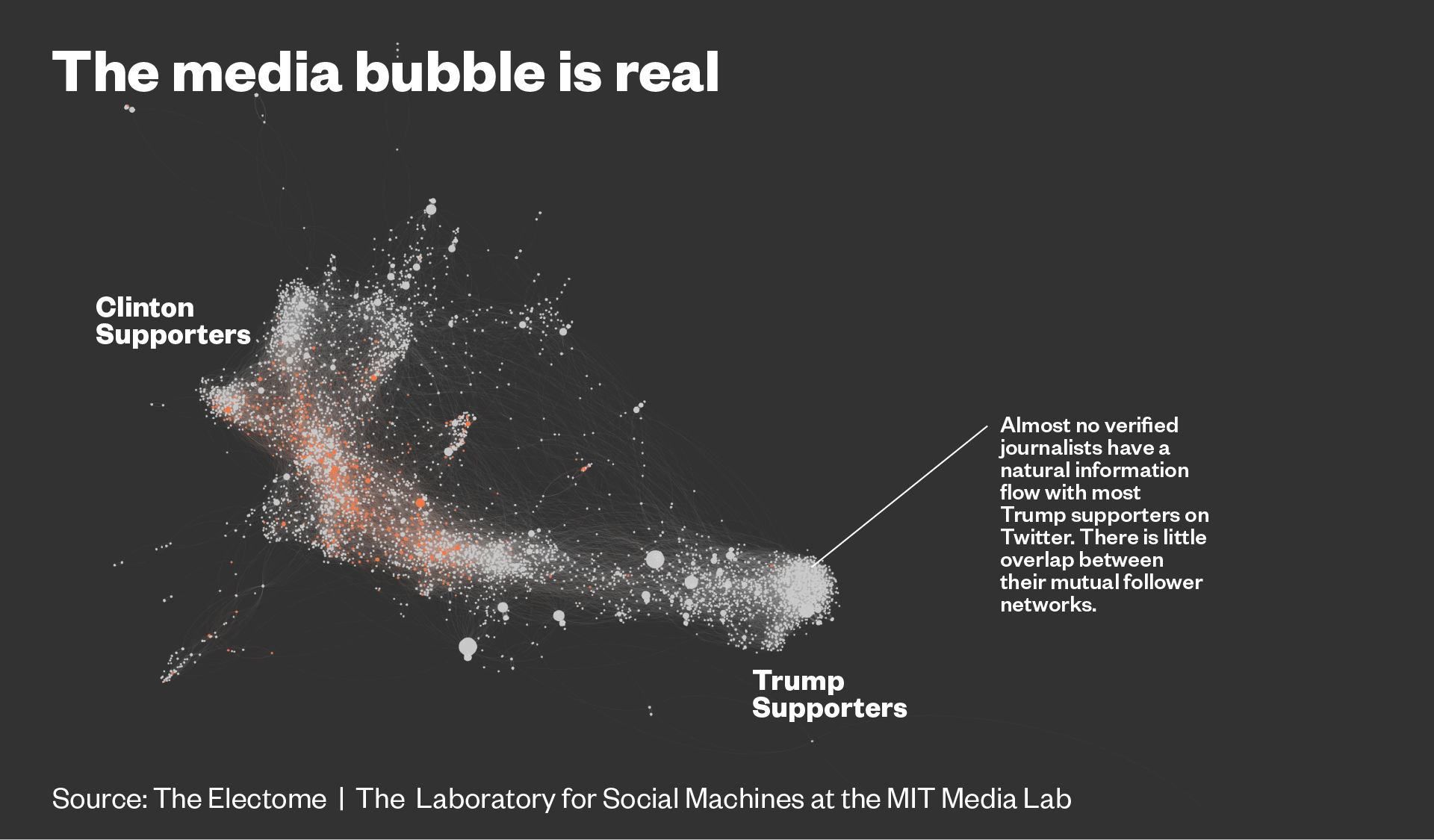
As for fake news, the picture is even more disturbing. The researchers found that almost no verified journalists on Twitter reached Trump supporters. If we take the view that journalists are generally trustworthy, I find it scary to think that social media (or Twitter at least) seems to be utterly failing at creating a universal set of facts. Quite literally, Twitter seems to be allowing people to live in different worlds.
My takeaway of this is that people use social media as a form of entertainment primarily, NOT to inform themselves. Entertainment is supposed to feel good, and confronting cognitive dissonance/different opinions is rarely comfortable, let alone good feeling. Before the internet, the nightly news was how people learned about issues (a fairly consistent set of facts). Discussions took place in real life, where it's difficult to dismiss someone as "bad" because their humanity is clear. In person conversations require that both parties at least give the impression that they are considering the others viewpoint. The same is clearly not true online. The end result seems to be a technologically enhanced ideological polarization (which I would guess plays out like a negative feedback loop). Yikes.
The researchers found that Trump supporters (just follow Trump) associated very little with Clinton supporters (just follow Clinton) or those who follow both Clinton and Trump. They found that following only one candidate predicted actual political support very well.
On issues like gun control, those who actively discuss the issue tend to fall solidly into either Clinton or Trump's camp and don't interact much. This is pretty scary to me considering that we always hear about how social media and the internet can help expose people to other viewpoints. I see this research as a strong indication that there is a tendency (at least at the political extremes) to reinforce existing beliefs, not facilitate meaningful dialogue.
As for fake news, the picture is even more disturbing. The researchers found that almost no verified journalists on Twitter reached Trump supporters. If we take the view that journalists are generally trustworthy, I find it scary to think that social media (or Twitter at least) seems to be utterly failing at creating a universal set of facts. Quite literally, Twitter seems to be allowing people to live in different worlds.
My takeaway of this is that people use social media as a form of entertainment primarily, NOT to inform themselves. Entertainment is supposed to feel good, and confronting cognitive dissonance/different opinions is rarely comfortable, let alone good feeling. Before the internet, the nightly news was how people learned about issues (a fairly consistent set of facts). Discussions took place in real life, where it's difficult to dismiss someone as "bad" because their humanity is clear. In person conversations require that both parties at least give the impression that they are considering the others viewpoint. The same is clearly not true online. The end result seems to be a technologically enhanced ideological polarization (which I would guess plays out like a negative feedback loop). Yikes.
Blog #10 - Kayla Snell - #fitspiration
I'm realizing that many of my blog posts feature something health and fitness related. I don't know if it's a little overboard or not, but if it is at least I can say that good health is something worth spending time and energy on. Today's episode of health and wellness features Instagram and #fitspiration. To be clear, Instagram is one of my favorite digital media platforms. It allows for creativity for photographers and any old smartphone user to be shared with friends, family, or anyone really. There's a lot of quite beautiful photographs, and I enjoy the minute long cooking videos and other so-called food porn. Plus, I personally really enjoy having a platform where I can share the coolest photos a photography noob such as myself can take.
However, it is also another platform for the continuing discussion on unrealistic standards. The photographs with the most likes are absolutely always digitally edited. This is also hugely important for people looking to better their health. Something we are always told to do is visualize our goals, find role models, and use that to inspire and motivate us. So when we're looking for these role models to inspire us with the ideal body, we look to Instagram's hashtags #fitspiration and/or #bodygoals. The problem is that these goals are so unrealistic. These are people who spend multiple hours every day in the gym, who haven't so much had a slice of birthday cake or a sip of alcohol in years, have given up the right to be spontaneous, and keep track of their calories so closely that they have to measure out their spinach every meal, and more. They're the body builders who've almost hit essential body fat, ( ~4% for men, ~6% for women), people who work in the gym for a living, models who have to remain strictly on diets to remain thin, the genetically gifted, or the ones who bypass all this by taking steroids. None of which they'll admit.
All this changes our society's ideal of the perfect body, and changes our perception of what is attainable. When the people in the #bodygoals photographs start pushing supplements or workout programs insisting that anyone can do it too, regardless of job or family situation, they're not being honest. Suddenly, everybody wants a 6-pack without quite understanding how much work goes into it, how much they will have to give up, or how dangerously low our body fat percentage needs to be in order to achieve it. Before digital media such as Instagram came into people's hands, the only other time I saw anyone with the equivalent to those #bodygoals people were in advertisements in magazines. Those I brushed off because I knew it wasn't authentic, it was touched up, and magazines were more money than I thought they were worth anyway. I only ever picked one up while waiting in the dentist's office. People have been discussing unrealistic standards in beauty for as long as I can remember, but it wasn't until Instagram before I truly saw unrealistic standards and more portrayed as being attainable.
As for what we can do, I think we shouldn't compare ourselves to what we find on the internet so often. I've learned it's much better to compare myself today to myself yesterday. Seeing progress with myself is usually way more motivating than trying to reach the standard of someone who's been doing this 10 more years than I have. Additionally, the online fitness community can do more to be open and honest about the amount of work it actually takes to get somewhere. A couple of such people I follow do, which is a good start.
Hiding behind the screen
The first thing I thought of when thinking of how the internet changes people, is how people interact with and without the internet. I remember a scene from Big Bang Theory when two people are on a date but both have trouble talking in person. The solution was to be on a date and text. The point is, people are more confident on the internet. Any kind of forum on the internet will no doubt be filled threats, name calling and things of that nature. People seem to find it easy to say things, they would otherwise never say, on the internet because there are no direct consequences. The comment section on a post on facebook is the same way. Everyone has become an expert with a simple google search and cannot wait to rub it into someones face on the internet. I believe this change is horrible. People become less adequate in normal human conversations and have to rely on the internet to communicate. Worse yet, I think this behavior is extremely contagious. One person insults another and it starts a never ending stream of insults thrown at people. It is like one person sees this behavior and believes the only way to 'fight' back is to do the same. Or even they feel like it is okay because everyone does it. As a person, I find this behavior repulsive and do not understand it. I think the solution to this problem is to ignore people. Because I think many of these trolls do it just to get a rise out of people, so by fighting with insults people just fuel the fire. I think as a society we should condemn this sort of behavior.
#10
One way I've seen the internet create change recently has been the #MeToo movement. This one is tough because it has been used in both good and bad (to me) ways, both of which I will talk about here. The movement was really simple; people would post on social media with the hashtag #metoo as a way of identifying themselves as victims of sexual assault, abuse, or harassment. The movement intended to show the world, men in particular, that nearly every woman has experienced these in some way. It was a powerful image, and it lead to powerful solidarity. Women in Hollywood began fighting against and exposing the harassment and unequal treatment of their workplaces, and the conversation has been generally brought out into the open.
I can see the #MeToo movement working similarly to Elliot's ideas about apotemnophilia. This movement did not create more survivors of various crimes, instead, it created a space and, more importantly, language to allow women and others to categorize those experiences. Women who might previously lacked the words to describe their experiences heard similar stories and were finally able to put a name to it. It allowed them to feel validated in their emotions about these events because they were acknowledged and named as bad rather than ignored and lumped into normal life. For many women, the movement has helped them to name their experiences and find solidarity in their feelings, which can be extremely healing for many.
The #MeToo movement has also worked in the opposite way that Elliot proposed as a possibility-- that the naming and popularizing of a term or idea might make people decide to identify with it where they wouldn't have done so previously. The other side of all these women coming forward are the people, often men, who have hurt them. At some point, some men decided that the #MeToo movement was full of women overreacting, and rather than work on respecting women more, they expressed fear of having women around them at all. A few people set forth the idea that these woman might be overreacting to simple, everyday business and personal relationships. Many more men, especially in business, then jumped onboard with this idea, identifying any contact with women as the dangerous to them personally and therefore further excluding women from fields where they are trying to gain more access. In this case, once the idea that "men being around women in a professional setting is dangerous to the men" was spread on the internet, more and more men began fitting their previous experiences into this model and reacting accordingly. The presence of this new idea let them ignore the potential truth--that they might have treated women poorly--and focus on the new problem with which they newly identified themselves.
This movement has sparked both positive and negative reactions, and it shows nicely how identifying an issue on the internet can quickly lead others to follow, for better or for worse.
Blog 10: Still Working
There are many reasons to complain against the internet. Cyberbullying, online stalking, cat fishing, etc. are just some of the few to mention. However the internet is a tool, and like all tools, it can be used for good and bad. Unlike the one ring to rule them all (that's right, I went there), the internet does not turn all of its users into desperate, obsessive shells of their former selves. Some people might refer to it on occasion as "their precious" but as long as they don't hide in a cave and attack anyone who tries to steal their internet I think they're ok. Honestly, I think it has made us more self reliant. There's so much information out there that we can learn to do a whole bunch of stuff on my own. For example, last week, the toilet in my apartment was constantly running water. No one knew what to do, so I looked it up on my own, followed the instructions that I found on a website, and was able to fix the problem. Easy peasy. Nowadays, we can solve any home or apartment issue just with a few clicks without calling for professionals. Although, this situation isn't just limited to home improvements. You want to learn how to moonwalk? Youtube it. You want to solve the Legendre equation? Look up a video on Kahn Academy. How bout you're in the mood to make a creme brûlée? Try some tasty Tasty Videos. See, the internet is full of so many tutorials that we can learn anything we want, from the obscure and esoteric to the trendy and essential.
Blog Post #10: Dating Apps Suck
When I think about examples of digital
media that have changed us, I immediately think of dating apps. Dating apps
suck. Even besides the significant fact that women often face harassment (despite
attempted remedies like Bumble), dating apps have mechanized the way that
people who’re looking to date meet, making a very personal process impersonal
and standardized, and reducing it all to a numbers game. I sound like an old,
cynical person – I know – but it seems that people really don’t talk to each
other when they have the option to effortlessly swipe. And I don’t want the first
thing a potential partner knows about me to be my stance on pineapple pizza, or
whether water is wet; but it’s weird that that’s in fact what’s typically
included in a Tinder bio.
Dating apps are also usually “freemium”.
Like Clash of Clans or Candy Crush, it’s technically free – but if you want to be
successful at it, your chances are better if you give up some money for premium
access. In dating apps, these premium advantages take the form of unlimited
swipes, more “super likes”, and even the ability to see who’s swiped right on
you before they show up in your “stack”. But this is absurd – as one pays money
not to date, but for the opportunity to meet someone to date. You can meet
people in real life, for free.
Additionally, transforming dating
into a numbers game is, I think, the result of the capitalist necessity for
increased efficiency. To someone in a late-capitalist economy (us, very
arguably), time is money. One is
thought to be: 1) wasting time by waiting to bump into an actual person who
reciprocates interest; and 2) probably too tired from working long hours to put
in the time and effort not to resort to dating manifested as swiping left and
right. The alienation of work begets an alienated form of dating. And maybe
this would be fine if reducing dating to a numbers game weren’t awful, but it’s
awful. No one is special or even
human: dating as a numbers game reduces dating-app users to their existence
within the context of the dating app (and more so than dating in real life
reduces people to a dating-specific context) – no one is seen as a person, with
the dynamic and interesting qualities that characterize people, but instead only
as a “dateable”, with an opinion on pineapple pizza.
Furthermore, in multiple ways,
dating apps are making us lazier. According to journalist Cady Drell, dating
apps disincentivize those in relationships from really giving it their all. In
her words, “If dating is like fishing off the side of a ship, then mobile
dating is like fishing from a glass-bottomed boat. Since you’re now keenly aware
of how many fish are swimming around at a given time… You’re less likely to
invest the energy working through problems when there are all those other,
ahem, fish in the sea.” Beyond this, it can be seen that dating apps have made
us lazier by the phenomenon of “ghosting”. Making dating impersonal provides a
sense of anonymity for both parties that makes simply cutting off contact
without explanation – something that was previously unthinkable – not uncommon.
In the context of Benjamin’s theory of aura, dating apps have irreparably destroyed
the “aura” of our romantic relationships – since it’s not really special if it’s
easily reproducible, is it? He or she isn’t as “one of a kind” as their partner
would’ve perceived them to be 30 years ago. But what’s worse is that, due to
the mechanization of dating apps, people
and relationships are losing their unique aura – not just pieces of art.
I think that we may be getting
better at dating, but we’re certainly getting worse at relationships. This isn’t
to say dating apps are 100% bad all the time – I know plenty of people in happy
relationships who met on dating apps. But as a system and as a whole, they’re
changing the way that we date, and probably for the worse, making dating more
superficial, and making us lazier and less considerate (while simultaneously
taking our money).
Source: https://www.glamour.com/story/what-have-dating-apps-really-done-for-us
Subscribe to:
Posts (Atom)