Most of us dream of a magic pill to kick off the extra pounds we’ve magically acquired (mostly likely from our drinking and late night habits) because god knows going to the gym and eating clean actually takes work—who wants to do that?! On my search to find this magic pill, I stumbled upon a diet pill I remember seeing my mom take when I was younger.
Alli (orlistat 60 milligram capsules) is the only FDA approved over-the-counter aid for weight loss. Orlistat is a lipase inhibitor and binds to enzymes that break down fat, it claims to block 25% of ingested fat from being absorbed. This pill also claims that for every 5 pounds you lose through diet and exercise, it will help you lose 2-3 more.
Inactive Ingredients: FD&C blue no. 2, edible ink, gelatin, iron oxide, microcrystalline cellulose, povidone, sodium lauryl sulfate, sodium starch glycolate, talc, titanium dioxide.
Ingredients: Active Ingredients: In Each Sealed Capsule: Orlistat (60 mg). Purpose: Weight Loss Aid. Inactive Ingredients: FD&C Blue 2, Edible Ink, Gelatin, Iron Oxide, Microcrystalline Cellulose, Povidone, Sodium Lauryl Sulfate, Sodium Starch Glycolate, Talc, Titanium Dioxide.
A 60 count goes for $40 and is supposedly for men and women however, it appears to be only marketed for women. Ads for Alli contain slim women: one holding a measuring tape around her waist indicating all of the invisible weight she has lost, one smiling woman in a bikini, and even one cheering on a scale. In this particular commercial ad, a woman is praising how much it has helped her and that the actresses ‘doctor’ husband wouldn’t let her take it if it wasn’t safe:
https://www.youtube.com/watch?v=hDKCvRknIeE
While the pill aims to improve a healthy lifestyle, it’s marketing to a specific gender is something to be noted. In society there is a beauty standard that slim women are beautiful. The fact that Alli markets the female population, while largely ignoring males, shows the capitalization of this beauty standard by weight loss pill manufacturers. Through this beauty standard the weight loss pill becomes gendered and indicates that it is the women who must pay the price, literally and figuratively, for beauty.
Saturday, March 3, 2018

Blog #5 - Kayla Snell
I was really happy to see that feasting our eyes on the supplements at the GNC was a possibility for this prompt, because that is something I do on a regular basis anyway. Particularly for the protein powder. I've been trying to navigate the fitness industry and their "quick fixes" as well as the supplements for about half a year so this isn't entirely foreign. A common theme in the marketing of these powders is that they are most commonly associated with dark colors, powerful figures, and promises to make the consumer lean quicker than ever before. Ninety-nine percent of the time, these products are geared towards men while the weight loss supplements are pushed towards women.
That brings us to one particular protein powder I am happy to rant about. It is branded as "Ladyboss Lean" and it is marketed in a way that hits women right in the insecurities and treats is like the magic cure to all our weight loss problems. Supplements all geared towards men? No worries, this one is just for the ladies! Craving something sweet? Never fear, avoid the tub of cookie dough with a protein shake instead! Cant find time to prepare a meal? Here's a quick and easy meal replacement that'll keep you feeling full for hours! The product is highly pushed by a bubbly, jacked as heck blonde girl who regularly posts videos of her preparing her "workout stack" on instagram, aka protein shakes and other supplements, often times wearing hot pink to match her shaker bottle and supplement packaging. Another huge component is that all the ingredients are "backed by science" and include patented ingredients such as fibersol and digeseb. (Link for this information below)
I don't doubt that it took lots of time and development to put together, and this coupled with the marketing tactics is why it bears so much similarity to the drug industry. However, its more of a marketing gimmick than anything. That was why I really appreciated the guy who said that protein powder is nothing more than "filtered milk" and "a f***ing cheap and convenient way for athletes to hit their protein requirements, but it's not magic." This means that 1) protein isn't any more "formulated for men" or "formulated for women" than a steak or a doughnut, and 2) I got taken for a sucker with this product. Thank goodness this guy exists. I ended up switching to a different product, that had essentially the exact same ingredients, but was priced $1/serving cheaper that the Lean product. Funny how this sort of thing works.With all the supplements for diet and bodybuilding, this is only one of many facets.
https://ladybosslabs.com/lean09ja5409j095ja0935
Benzo
One of the first things that comes to my mind with at least stigmatized drugs is Xanax. Once a drug that would treat chronic pain and anxiety that suddenly became the ultimate party drug. I decided to look further into these kinds of medications. Xanax, or alprazolam is a type of benzodiazepine. Typically used to treat people who are suffering from severe anxiety or panic attacks. Xanax is also the 12th most prescribed medication in the United States. Xanax as well as every other benzodiazepine works in the same way, by reducing brain activity, particularly by enhancing the effect of GABA in the brain. This reduction of brain activity is used to treat many different types ailments such as panic disorders, muscle spasms, seizures, sleeplessness, alcohol withdrawal, and even premenstrual syndrome. And in fact, I even saw that Xanax is sometimes prescribed for people with PMS. What I found even more interesting is that these benzodiazepines are quite addictive as they create a tolerance, altering your natural chemical composition and creating a need for a greater dosage, yet they are commonly prescribed to those suffering from alcohol withdrawal. Even within the articles I was reading about it, it cautioned its use for people who have ever struggled with addictions as they would be more prone to become addicted to even the prescribed amount of benzodiazepines. Seems pretty ironic to me, that an addictive med would be prescribed to those recovering from addiction, but I suppose that happens when we feel the need to prescribed something for everyone. And I suppose reducing brain activity is something that everyone could use sometimes.
Blog #5
Honestly, this blog assignment made me struggle what I should write about. To write something thoughtful here you need to live in that culture: have some medicines your family always used, see ads on TV, visit a doctor and go to pharmacy's. With my 7.5-month experience in US (fortunately, with no suddenly appeared illnesses) it is extremely difficult to talk about this topic. But I will try to make my point explicit enough.
First of all, I'm the one who is an exception from majority of people who take brand-name medicine because "it helps them better". For me usually they work worse. The worst situation was with allergy. It seems that I was always allergic to something: at first, it was complete milk intolerance, then it disappeared, but now is replaced with tree pollen allergy (spring is coming!) that also goes with severe food allergy. So problem with antihistamines was always urgent. At some point I got used to a medicine with Cetirizine as main component, so it stopped helping me. I needed a replacement and really fast.
First choice recommended by doctor was Claritine (at least some brand names are the same). This brand is hugely advertised on TV (even ads are the same as described in a post about Claritine published before mine - colorless world becoming colorful). Average price is about 5$ for 10 pills. But they didn't work. At all. I got only side effects - dizziness, drowsiness, but no actual effect. So I came to the pharmacy again and ask for equivalent pills, something that can help me. So I got another pills with name Lorahexal (it is not available in US). The same antihistamine - Loratadine, the same concentration - 10 mg. But price is different - 50 cents for 10 pills. 10 times difference. Less side effects - Claritine may affect liver and kidney, Lorahexal - only liver. And Lorahexal actually worked for me.
So my choice is for generics. If now I get prescribed new medicine, I will definitely look for other names that offer the same active ingredient. And yes, they work better. Maybe it is "opposite placebo effect" - I don't want to spend more money for the same product, so I convince myself that cheaper pill will work better than more expensive one, so I can save money. This can also be an explanation. But while it works I have no reason to change it.
Blog Post #5: The Cultural Marketing of Anacin and Excedrin
In thinking about drug hybrids, what immediately came to mind for me were literal drug hybrids – or drugs that market themselves by focusing on the claimed extra efficacy that comes from combining multiple active ingredients into the same pill or capsule. One example of this is Anacin, which is still around today, but was more popular during the early to mid-twentieth century.
Anacin combines aspirin and caffeine to “relax tension,” and “help overcome depression,” and was invented by a Minnesotan chemist in 1915. The thought that an over-the-counter pain reliever could “help overcome depression” definitely seems odd today, but Anacin was specifically marketed (like in this ad) to foster this belief, as well as invent the idea of mental “tension” as a physical problem separate from headaches – that only Anacin, with its magical combination of ingredients, could alleviate.
An Anacin advertisement that I found especially interesting was this one from the 1960s. In it, a man dressed in a suit and tie comes home, and snaps at his wife rather aggressively due to headaches caused by stress from work. But the advertisement is also selling a set of beliefs to the consumer: you’re a hard-working man, you get stressed, you don’t want to yell at your wife, you should take this pill to suddenly become happy and more sociable with your family. It sells a heteronormative point of view combined with a sense of the Puritan work ethic, with the commercial focusing on a man coming home from work to his wife. After all, what is the man to do? Quit his job and fail to provide? Give up on trying to support a conventional nuclear family? Treat his wife like a person? (surely not that last one). No one is coerced into asking why one has to work a job that consistently causes them headaches when they can just take a pill to relieve that “tension.”
A newer drug I found operates similarly to Anacin, both medicinally and culturally. Excedrin, another over-the-counter pain reliever, contains acetaminophen, aspirin, and caffeine as active ingredients (adding only acetaminophen to Anacin’s mix). This Excedrin commercial from late last year features an unusually handsome EMT who suffers from migraines – and details how Excedrin helps him perform in such a high-stress job. To do this, the commercial illustrates how the “camaraderie” the EMT feels with his co-workers makes him feel that he needs to be capable at all times, instead of suffering from migraines that would distract him while on the job. This advertisement seems to repackage the same selling points of the second Anacin commercial linked above. The man (who seems conventionally handsome like the man in the Anacin commercial) is under stress because of his job, has social responsibilities that motivate him not to fail his partner (in this case, his fellow EMT and not his wife), and thus needs Excedrin to make him more capable of handling workplace stress. While this commercial is more modern and subtracts the heteronormative aspect from the marketing – the social obligation being with his co-worker – it still sells the idea to the consumer that one must be competent in their work. Sure, not everyone is an EMT, but the advertisement features an EMT because everyone can relate in the stress they feel from their own job, and the idea that they have to be at the top of their game. Additionally, as Anacin did, Excedrin sells the belief that if you want to be a man’s man who is capable in their work (because what’s more manly than saving lives?), Excedrin will help you get there.
Both Anacin and Excedrin aren’t just formed in laboratories, but are also culturally formed. Both utilize marketing to be relatable to the consumer while offering a way to overcome stress from the workplace. Both draw on the multiplicity of ingredients in their drug to claim extra efficacy (even though the multiple ingredients, in their similar functions, are probably redundant). And both profit from making the consumer visualize the amount which other people depend on them, in order to bring the consumer to the conclusion that they need the drug to feel better, for the sake of the other people in their life.
Other sources: https://www.madeinchicagomuseum.com/single-post/2016/10/14/anacin-company
Blog 5: The Usual Suspects
Dimetapp. The bane of my existence. Everyone had that one medicine that they were forced to swallow down whenever they were sick as children that made them want to puke and mine was the grape flavored monstrosity. Dimetapp is your basic over the counter cold allergy medicine that supposedly relieves you of nasal congestion and itchy, watery eyes. However, we all know theres a dozen other medicines we can name from the top of our heads that can do the exact same thing. You got the usual suspects: Benadryl, Claritin, Zyrtec, Allegra and NyQuil. All of them do the job of temporarily relieving the symptoms of a lingering cold and are all antihistamines. Naturally this is due to branding and marketing causing people to pay more than what is necessary. Yet, I think it is also important to mention that sometimes we don't always need to use over the counter medicines to alleviate our symptoms because there are plants that do the exact same thing.
First off, there are a lot of science articles and history in general that prove that medicinal plants and herbs work just as well. For example, this link, https://www.ncbi.nlm.nih.gov/pmc/articles/PMC3358962/, is an article published by a professor in the department of pharmacognosy detailing the uses and types of plants used in world history. She lists the Vedas as an example since it includes treatments with plants in its scriptures and Charles the Great, who founded the reputed medical school in Salerno, because he grew medicinal plants on the state owned lands. To be even more specific, she mentions that "In the Middle Ages, the skills of healing, cultivation of medicinal plants, and preparation of drugs moved to monasteries. Therapy was based on 16 medicinal plants, which the physicians-monks commonly grew within the monasteries as follows: sage, anise, mint, Greek seed, savory, tansy, etc." Proof! Or if you want more, here's this other article, http://www.plantphysiol.org/content/124/2/507, listing plants with their medicinal uses and the chemical compounds they're composed of. For instance, Kava is a plant in the western pacific that is noted for its "treatment for anxiety, nervous tension, agitation, and/or insomnia. Clinical studies have shown an effectiveness of Kava that is comparable with sedatives such as benzodiazapines but without the development of either physical or psychological dependency". It's all very interesting to consider. So yes, medicine is helpful but very concerned with branding but if you have a headache or cold and want to try something different, but has actually been used for thousands of years, then maybe take a trip to your garden.
Blog #5: So What's the Difference?
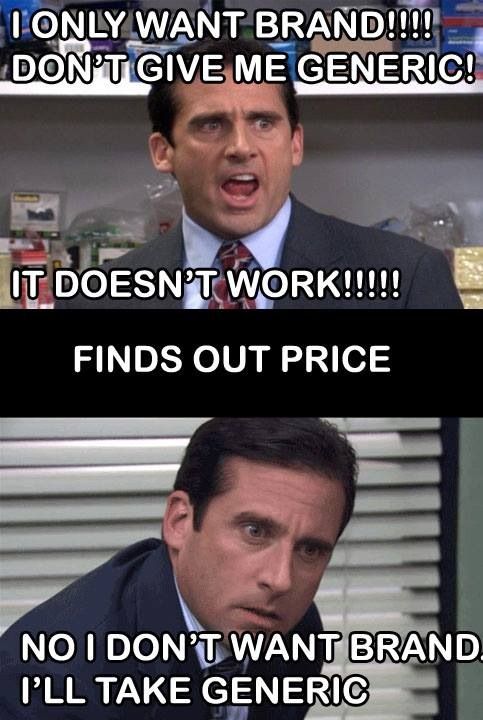
Going to the pharmacy has become a part of who I am, and a place I have come to spend a lot of my time in the last two years. I’ve dealt with numerous customers wondering if they should get the brand or generic, yet some still choose the expensive brand even after explanation from the pharmacist. And then you get the people who Michael Scott so famously described (not really):
Today I want to discuss Mucinex, mostly because I’m sick of their commercials. I’m sure you all know what I’m talking about, the ones with the gross, green mucus man trying to prevent someone from going about their day-to-day activities. What I really want to look into is how Mucinex compares to other cold and flu medications like DayQuil/NyQuil. Kind of like the brand vs. generic question, I’m wondering how different all of the various cold/flu medications can truly be. While doing some research, I found a commercial that stood out to me. A sick customer was reading a Mucinex box when Mr. Mucus approaches him with a box of DayQuil, telling the customer that he should just get this one. While I’m an avid DayQuil user myself, the customer in the commercial insisted that Mucinex had more helpful ingredients to combat his illness. I wanted to look into this to see if there truly was a huge difference, or if for the most part either drug would suffice. What I found wasn’t surprising, and when choosing between the two different drugs it truly just comes down to which symptoms you’re looking to treat. Much like NyQuil/DayQuil, there are many different types of Mucinex products. The varying products are special and target different cold/flu symptoms. When just looking at plain Mucinex and plain DayQuil, the major difference between the two is that Mucinex contains an expectorant called Guaifenesin. BUT, if you look hard enough, you’ll find “DayQuil Mucus Control”, which contains the magical Guaifenesin ingredient that Mucinex highlights in their product. Overall, I know that these two products are different, and choosing one comes down to the cold/flu symptoms you are looking to treat. But in my small amount of research, it sheds some light into how similar all of the marketed cold/flu drugs are, with little differences in ingredients. I know I’ll be learning a lot more about these various drugs throughout the next few years, and my current understanding on the subject will certainly change, but I find it interesting how many products are on the market for just the common cold/flu. With so many products, it's no wonder customers can get confused on which drug they should truly take..
Today I want to discuss Mucinex, mostly because I’m sick of their commercials. I’m sure you all know what I’m talking about, the ones with the gross, green mucus man trying to prevent someone from going about their day-to-day activities. What I really want to look into is how Mucinex compares to other cold and flu medications like DayQuil/NyQuil. Kind of like the brand vs. generic question, I’m wondering how different all of the various cold/flu medications can truly be. While doing some research, I found a commercial that stood out to me. A sick customer was reading a Mucinex box when Mr. Mucus approaches him with a box of DayQuil, telling the customer that he should just get this one. While I’m an avid DayQuil user myself, the customer in the commercial insisted that Mucinex had more helpful ingredients to combat his illness. I wanted to look into this to see if there truly was a huge difference, or if for the most part either drug would suffice. What I found wasn’t surprising, and when choosing between the two different drugs it truly just comes down to which symptoms you’re looking to treat. Much like NyQuil/DayQuil, there are many different types of Mucinex products. The varying products are special and target different cold/flu symptoms. When just looking at plain Mucinex and plain DayQuil, the major difference between the two is that Mucinex contains an expectorant called Guaifenesin. BUT, if you look hard enough, you’ll find “DayQuil Mucus Control”, which contains the magical Guaifenesin ingredient that Mucinex highlights in their product. Overall, I know that these two products are different, and choosing one comes down to the cold/flu symptoms you are looking to treat. But in my small amount of research, it sheds some light into how similar all of the marketed cold/flu drugs are, with little differences in ingredients. I know I’ll be learning a lot more about these various drugs throughout the next few years, and my current understanding on the subject will certainly change, but I find it interesting how many products are on the market for just the common cold/flu. With so many products, it's no wonder customers can get confused on which drug they should truly take..
Subscribe to:
Posts (Atom)